On International Workers' Day, as protests around the world linked economic hardship to U.S. military aggression, Donald Trump issued an executive order intensifying his administration’s war on the Cuban people.
This week, we look at the sweeping order, which is the latest escalation in a decades-long economic war designed to bring about regime change by suffocating the island’s economy.
Also:
Amid U.S. Aggression, Cubans March on May Day
U.S. Voices Against the Blockade
Cuba’s “Magic Formula” for World-Class Musicians
New Report: Cuban Babies Killed by U.S. Sanctions
Senate Blocks Resolution to Stop Attack on Cuba
Cuba Turns to Local Crude to Counter Oil Blockade
Fact-checking Marco Rubio
Cuban-American Billionaire on Trump Guest List
The Cost of the U.S. War on Cuban Doctors
ICE Arrests Multiply, Green Cards Diminish
Tourism Drops in Cuba Amid Oil Blockade
Cuba Collaborates with FBI in Kidnapping Case
Belly of the Beast Recommends
On May Day, Trump Ramps Up War on Cuba
Trump’s May 1 executive order is extremely broad, threatening sanctions against foreign individuals and entities determined by Secretary of State Marco Rubio to have “operated” in any “sector of the Cuban economy.”
In effect, the order gives carte blanche to Rubio, a Cuban-American politician from South Florida who has never stepped foot in Cuba, to go after third parties in other countries doing business on the island.
In addition to threatening to freeze assets, the order allows Rubio to impose a travel ban on any foreign individual who is considered to be in violation. The “adult family members” of these individuals would also be banned.
In addition, the order targets foreign banks that process transactions related to Cuba, which could further lock the island out of the international financial system.
The order is as nebulous as it is broad. For example, it does not define what an “adult family member” is — would a distant cousin be implicated? Moreover, key language is left vague, such as what it means to “have operated” in the Cuban economy.
The vagueness is likely intentional, creating a climate of fear in which companies, not knowing when they would be in violation, would avoid Cuba altogether.
The pretext: “national security.” The goal: “pain.”
The order invokes a supposed “national emergency,” arguing that Cuba poses an “extraordinary threat.” The administration issued a "fact sheet" claiming that Cuba hosts foreign spy bases, sponsors terrorism, provides safe haven to Hezbollah, and drives migration to the United States. There is no credible evidence to substantiate any of these allegations.
The actual motivation behind the order’s extraterritorial “secondary sanctions” was expressed a year ago by then U.S. Special Envoy to Latin America Mauricio Claver-Carone, a Cuban-American hardliner and Rubio ally who has been a mastermind behind Trump’s hard-line Cuba policy.
Claver-Carone promised the administration would be “very creative” in imposing “modernized” sanctions targeting third parties. These sanctions, he said, would create “short-term pain” in order to bring about regime change in Cuba.
“In 2019, the policy was maximum pressure, but we never got to maximum pressure,” he said. “We didn’t even get to like 50% of maximum pressure. There's a whole bunch of stuff to go.”
Claver-Carone no longer has a position in the administration — officially, at least — but it seems that Trump is still following his playbook.
Amid U.S. Aggression, Cubans March on May Day
Thousands of Cubans marched this Friday to the José Martí Anti-Imperialist Tribune in Havana, in front of the U.S. embassy, as well as to squares and parks across the country, to celebrate International Workers' Day.
“Cuba defends itself” was the slogan of the marches, as people took to the streets to reject U.S. economic warfare and military aggression.
“Cuban people always amaze you,” said Josué Benavides, a solar energy researcher, while he marched. “The country is still functioning. The country has not collapsed. That’s an idea, a rationale, a narrative they’re pushing. They’re trying to make it collapse, but it hasn’t.”
Polls show most people in the United States oppose economic war on Cuba, yet one administration after the next — Republicans and Democrats alike — has advanced a Cold War-era approach dictated by Cuban-American hardliners from South Florida.
Increasingly, as Trump has ramped up U.S. sanctions, people in the U.S. are raising their voices to denounce a policy that amounts to collective punishment.
Renée is one of them. As a surgeon from Philadelphia, Renée recently visited Cuba, where she witnessed firsthand a healthcare system under severe strain: shortages of medicine and basic supplies, limited resources and constant blackouts that disrupt patient care.
According to Renée these restrictions are making medical treatment increasingly difficult.
“If it's true that it is the Cuban government that is causing the problems, then lift the blockade, let the oil in, and let's see what happens,” says Renée.
Check out our interview with Renee in Episode 1of our series U.S. Voices Against the Blockade.
Why do Cuban musicians make such an outsized impact on the global stage?
Havana-born violinist Yilian Cañizares says the island has a “magic formula” — a mix of public music education and a culture where music is part of everyday life.
“Cuban music has virtuosity, flavor, and cubanía, and I come to add a little sweetness, my feminine perspective,” says Cañizares.
Yilian has conquered international stages as a standout talent among Cuba’s new generation of musicians, but she frequently returns to Cuba to reconnect with her roots.
On her most recent visit to Havana, she sat down for an interview with Belly of the Beast journalist Liz Oliva Fernández.
By becoming a paid subscriber on Patreon, you gain early access to selected videos and documentaries and can attend a monthly live briefing with a Belly of the Beast journalist.
More importantly, your membership also helps support our on-the-ground reporting that you won’t find anywhere else!
New Report: Cuban Babies Killed by U.S. Sanctions
A new report from the D.C.-based Center for Economic and Policy Research (CEPR) has found that increased U.S. sanctions were likely the primary cause of a 148% rise in Cuban infant mortality from 2018 to 2025.
“If the rate of infant mortality had remained unchanged, then approximately 1,800 fewer babies would have died since 2018,” according to CEPR.
The report explains that up until the first Trump administration, Cuba’s health indicators paralleled European numbers, and often exceeded U.S. figures.
“The Trump policy of ‘maximum pressure’ on Cuba has killed a lot of babies — and, although we don’t yet have data for the last few months, it’s highly likely that more babies are dying now, and at an even higher rate than last year as a result of the current U.S. fuel blockade targeting Cuba,” said CEPR’s Director of International Policy Alexander Main, one of the report’s coauthors.
This sharp rise in infant deaths is part of a healthcare crisis that has been driven by U.S.-imposed economic strangulation.
On the ground, beleaguered medics are fighting to keep their patients alive.
“The decline in the survival rate of our children with cancer corresponds with astonishing accuracy with the hardest years for Cuba, with the increasingly severe measures that have been suffocating us,” Dr. Mariuska Forteza, who heads the pediatrics wing at Cuba’s National Institute of Oncology, wrote last week on Facebook. “Now it's the energy blockade. Without electricity and transportation, it's impossible to provide medical assistance. A child's life cannot be jeopardized in the name of anything. We doctors don't perform miracles. Infrastructure, resources, medicine and fuel are needed.”
To learn more about the impact of the U.S. government’s economic war on Cuba’s hospitals, watch the documentary Healthcare Under Sanction, which we produced last year for Al Jazeera.
The Cuba War Powers Resolution, which sought to stop Trump from taking military action against Cuba without Congressional approval, was blocked in the Senate Tuesday in a 51-47 vote.
Two Republicans broke with their party — Sen. Susan Collins (R-ME), who faces a challenging race in her Democrat-leaning state, and Sen. Rand Paul (R-KY) who has historically favored congressional control over military action — but the GOP’s Senate majority plus a breakout vote from Sen. John Fetterman (D-PA) ensured the resolution was blocked.
Democrats have introduced several similar bills aimed at curbing Trump’s unprovoked warmongering and unchecked use of military force in Venezuela and Iran, but the GOP majority has sided with the president.
Even as Cuba and the U.S. are reportedly holding talks, Trump has repeatedly used language suggesting that he is considering a military intervention in Cuba.
Two similar bills that would prevent a U.S. attack against Cuba have been introduced in the House.
Cuba Turns to Local Crude to Counter Oil Blockade
Cuba will start processing local crude oil without imported diluents, which the island is struggling to acquire as a result of Trump’s oil blockade, state-run newspaper Granma reported.
Cuba produces around 40% of the crude it needs to power the nation, but Cuban crude is dense, viscous and rich in sulfur. Its processing has so far relied on imported naphtha, another oil derivative.
Without access to naphtha, Cuban refineries are instead starting to use thermoconversion, or controlled heating. The Hermanos Díaz refinery, in Santiago de Cuba, has already successfully implemented the process. A second plant is currently being prepared to follow suit.
This new practice, as well as the installation of thousands of solar panels, seeks to reduce Cuban dependence on imported oil.
Over the past two weeks, blackouts in Cuba have significantly reduced following the arrival of Russian tanker Anatoly Kolodkin carrying approximately 700,000 barrels of crude. However, that was the first tanker to reach the island since January and no other has arrived since.
Fact-checking Marco Rubio
U.S. Secretary of State Marco Rubio this week once again repeated unsubstantiated accusations that Cuba is hosting foreign spy bases.
“These people in charge aren’t just economically incompetent,” he said on Fox News. “They have rolled out the welcome mat to adversaries of the United States to operate within Cuban territory against our national interests with impunity. We are not going to have a foreign military or intelligence or security apparatus operating with impunity 90 miles off the shores of the United States.”
Rubio has been making this claim for decades — without any credible evidence and without any pushback by reporters from major media outlets.
In January, the executive order justified the oil blockade by claiming that “Cuba hosts Russia’s largest overseas signals intelligence facility.” Cuba did host a Russian base but it was shuttered more than two decades ago. There is no evidence such a base still exists.
The accusation seemed to come out of nowhere since Rubio and other politicians had previously accused Cuba of hosting Chinese — not Russian — bases.
Belly of the Beast has investigated the claims about "China spy bases," but found no evidence of their existence.
“There’s no evidence that the Chinese are present there,” former CIA analyst Fulton Armstrong told us, describing a report by a D.C. think tank claiming the existence of the bases as “an interesting compilation of rumors and old speculation.”
Rubio's claims about spy bases are not the only falsehoods he has used to justify hard-line policies toward Cuba.
He has also insisted that the U.S. has done “nothing punitive” to Cuba and that the island lacks fuel because it “wants it for free” — not because of the oil blockade the Trump administration imposed.
Cuban-American Billionaire on Trump Guest List
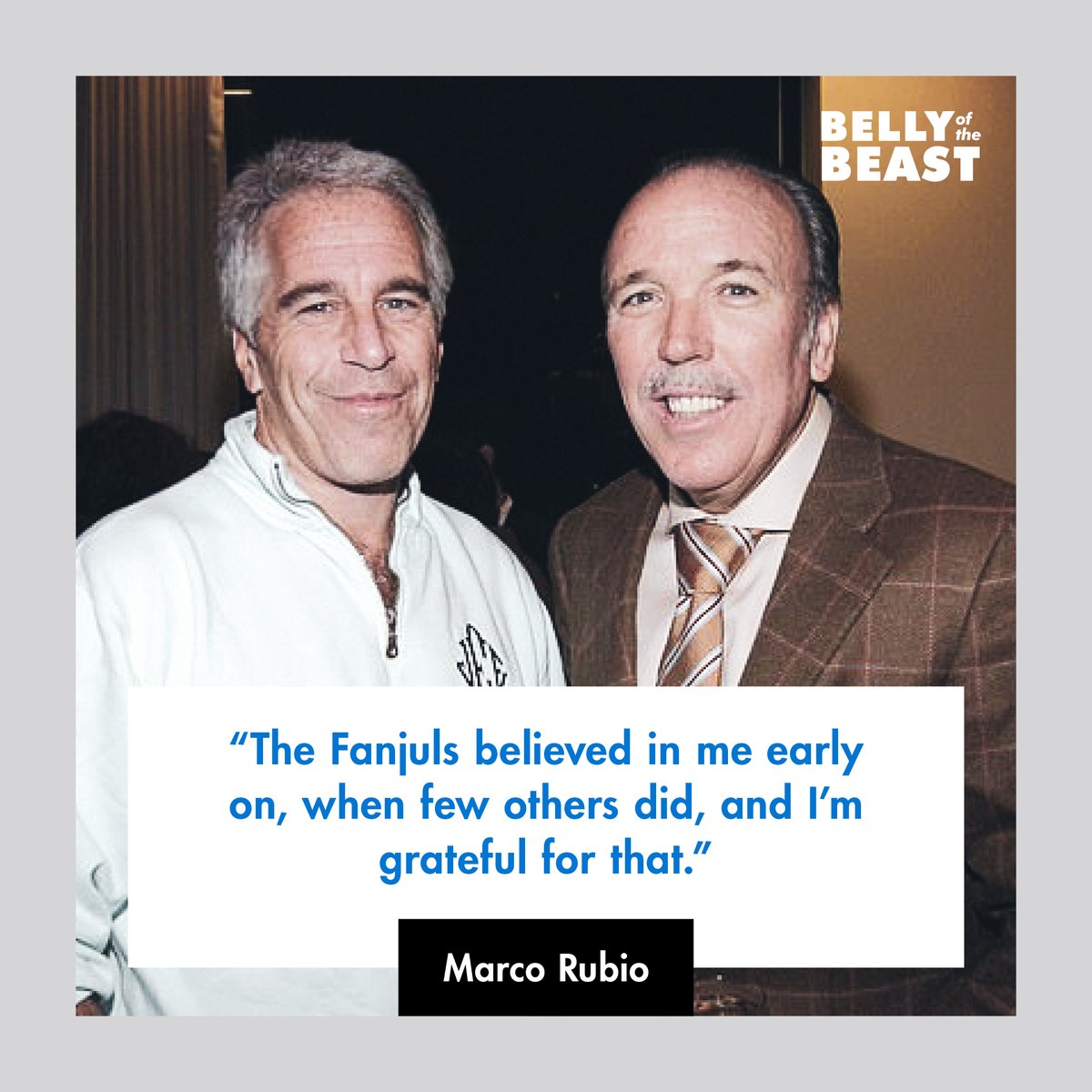
Some interesting names graced the guest list at Trump’s state dinner for Britain’s King Charles III, including José “Pepe” Fanjul and his wife Emilia, whose family controls a multi-billion dollar sugar and real-estate conglomerate and began funding Marco Rubio’s political career 25 years ago.
The Fanjuls are major power brokers in Florida. Their company, Central Romana, is also the largest private employer and landowner in the Dominican Republic. In 2022, the Biden administration blocked imports from Central Romana after U.S. customs officials found indicators of forced labor and abusive conditions among workers.
The Fanjuls donated millions of dollars to Trump’s campaign, and his administration quietly lifted the Biden era ban in 2025. Labor rights groups criticized the move, saying conditions had not improved.
Needless to say, Rubio, who has attacked Cuba’s medical missions as “forced labor” even though the doctors volunteer to go on the missions and are paid many times what they make on the island, has not expressed public concern for the sugar plantation workers employed by his benefactors.
The Cost of the U.S. War on Cuban Doctors
A Guardian report made a welcome departure this week from the tendency of major media outlets to frame Cuban medical missions as exploitation rather than solidarity.
As U.S. pressure forces governments to end healthcare collaborations with the island, the article highlights how communities across the Global South are feeling the loss acutely.
Featuring firsthand accounts from patients in Jamaica and Brazil, the piece explores the nuances of Cuba’s medical missions and the impact on underserved communities that are now left without essential care.
ICE Arrests Multiply, Green Cards Diminish
ICE arrests of Cuban citizens have increased nearly fivefold through Trump’s second term while green card approvals have slowed to almost zero, according to a CATO Institute report.
The study shows how Cubans, especially those who arrived in the U.S. legally under Biden, have fallen victim to a “concerted targeting" by the Trump administration, which has removed pathways for them to remain legally in the U.S.
Unlike immigrants from other countries in Latin America, Cubans have long enjoyed privileges in the U.S. under the Cuban Adjustment Act, which has allowed them to apply for residency a year and a day after their legal arrival in the country.
But those privileges have been largely stripped under Trump.
Hundreds of thousands of Cubans have seen their legal status and work permits revoked since last year. Many remain at risk of deportation while almost 2,000 have already been returned to Cuba since January 2025.
Tourism Drops in Cuba Amid Oil Blockade
Travel to Cuba has fallen by almost 50% in the first quarter of 2026 compared to the same period of the previous year, data shared by Cuba’s National Office of Statistics shows.
The period coincides with Trump’s oil blockade, which caused many travelers to steer clear of the island as blackouts increased and several airlines suspended their Cuba routes.
Though the oil blockade has exacerbated the drop in travelers, U.S. sanctions have been destroying Cuba’s tourism since Trump’s first administration. In 2018, Cuba welcomed almost 4.8 million travelers. Last year, it was only 1.8 million.
Cuba Collaborates with FBI in Kidnapping Case
A ten-year-old child has been returned to his biological mother in Utah following an FBI operation with support from Cuban authorities, the New York Times reports.
The child had been taken to Cuba by the other biological parent and her partner in the midst of a custody battle. They are both facing kidnapping charges.
Cuban law enforcement located them on the island and a U.S. government plane flew them back to the U.S.
Belly of the Beast Recommends
Joy Gordon, Professor of Social Ethics at Loyola University Chicago and author of “Economic Sanctions from Havana to Baghdad,” brings her expertise to bear on the current crisis in Cuba. Writing for Commonweal magazine she makes a meticulously argued and emotionally-charged case that what the U.S. is doing to Cuba today constitutes siege warfare: a deliberate strategy of collective punishment designed to bring a civilian population to its knees.
William LeoGrande breaks down what “taking” Cuba would mean for the U.S. and what could come out of negotiations between the two nations in an article for Responsible Statecraft. “As weak as Cuba is at the moment, there is no clear path by which Washington can achieve regime change. There is, however, an opportunity to re-engage with Cuba economically to the benefit of both countries, and that is a deal too good to pass up,” he says.
Consortium News reviewsTeresita’s Dream, Belly of the Beast’s documentaryabout Dr. Teresita Rodríguez Obaya, the Cuban scientist whose personal experience of her mother’s Alzheimer’s drove her to develop NeuralCIM — a potentially life-changing nasal spray, now approved in Cuba for mild-to-moderate Alzheimer’s treatment, which due to U.S. sanctions cannot be shared with the millions worldwide who could benefit. See more about Teresita’s DreamHERE.
DON'T MISS: Teresita's Dream in New York City
Don't miss the official premiere of our latest documentary Teresita’s Dream in New York City.
The film, which tells the inspiring story of Dr. Teresita Rodríguez, the Cuban scientist who helped develop a groundbreaking treatment for Alzheimer's, will screen at the Havana Film Festival New York on Sunday, May 3, at 1pm ET, at Quad Cinema in Manhattan (34 W. 13th St, New York, NY 10011).
Truly independent media relies on support from readers and viewers like you. Whether through a tax-deductible donation or by joining our Patreon community, you can help us continue producing independent, on-the-ground reporting about Cuba that you won’t find anywhere else.
Every contribution — big or small — strengthens our journalism. Thank you for being part of our community.
Boletines en Español | English Newsletters Archives A pesar de que la administración Trump ha castigado duramente a Cuba con un bloqueo petrolero y una serie de sanciones sin precedentes, el gobierno cubano continúa recibiendo a cientos de deportados de Estados Unidos, respetando así los acuerdos bilaterales de migración vigentes desde hace mucho tiempo. Pero no todos los deportados cubanos están siendo enviados de vuelta a la isla. Esta semana hablamos con Yasmany Moreno, un cubano que vivió...
English Newsletters Archives | Boletines en Español Even as the Trump administration has hammered Cuba with an oil blockade and a raft of unprecedented sanctions, the Cuban government continues to receive hundreds of deportees from the United States, honoring longstanding bilateral migration accords. But not all deported Cubans are being sent back to the island. This week, we speak with Yasmany Moreno, a Cuban man who lived in Miami for nearly a decade before the U.S. deported him to the...
Boletines en Español | English Newsletters Archives El gobierno cubano afirma que el embargo estadounidense causó más de 8.000 millones de dólares en daños en un solo año. Su último informe a las Naciones Unidas describe a cirujanos operando bajo la luz de un teléfono móvil, a una madre preocupada por la posible interrupción del tratamiento oncológico de su hijo y a niños que esperan vacunas retenidas en almacenes. Esta semana analizamos cómo la guerra económica del gobierno estadounidense...